Math // Algebra // Lab
Solving Linear Equations
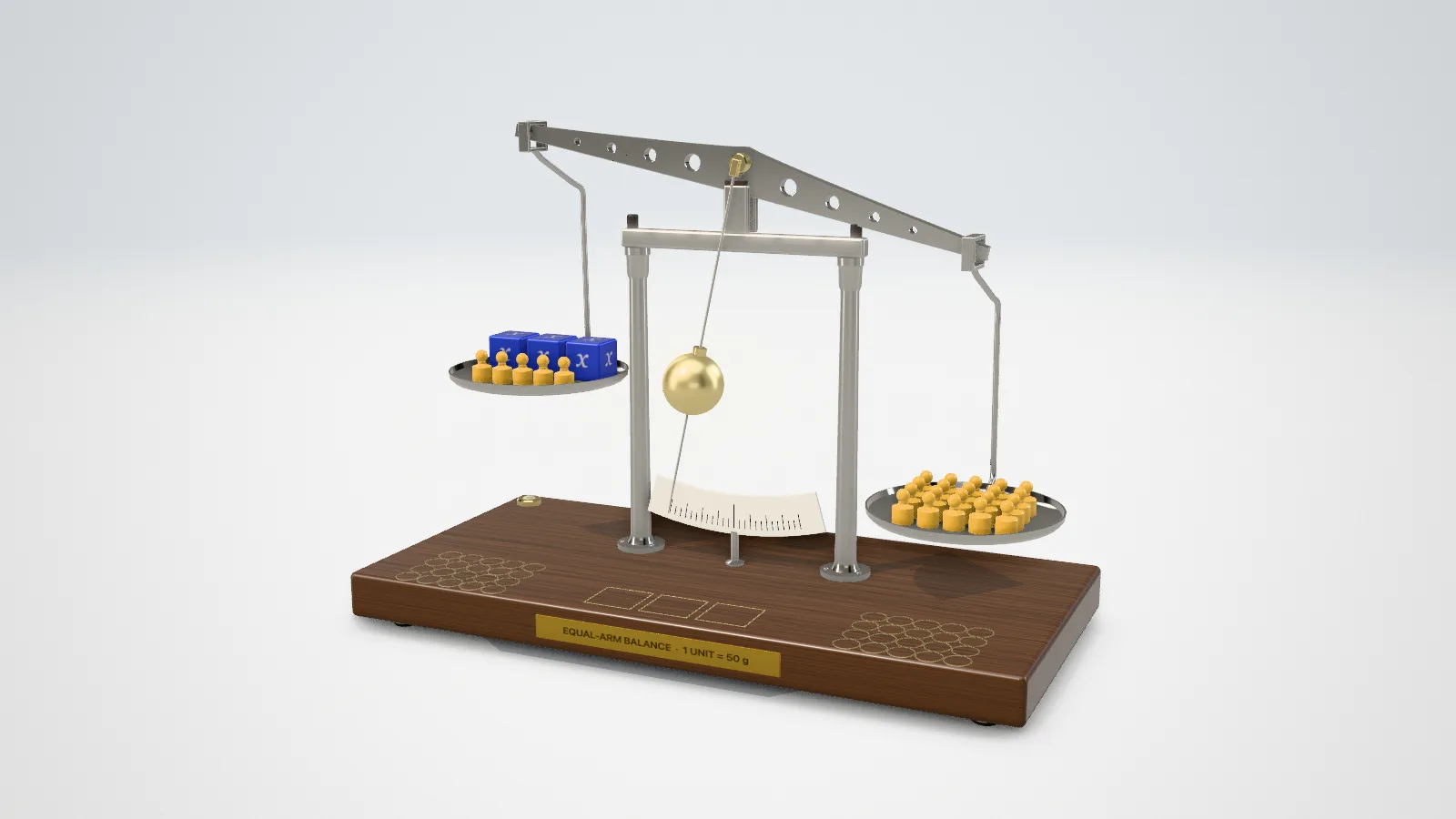

Topic // Balance 3x + 5 = 20
What this topic is
Use algebraic methods to solve linear equations in one variable, including equations that require rearrangement, expanding brackets, and collecting terms on both sides; solve equations with rational number coefficients
Quick check
If the learner is given an equation like 3x + 7 = 22, can they work through the steps to find the value of x?
Ask this to see whether the topic is secure.
Topic // Mastery
What mastery looks like
- Solve one-step and two-step linear equations in one variable
- Solve equations requiring expansion of brackets and collection of like terms
- Solve equations with the unknown on both sides and with fractional or negative coefficients
Topic // Map
Where this fits
- RequiredMust come first
- HelpfulHelps, but not essential
Before this
4 topics- Writing Algebraic EquationsRequired
Algebra // Ages 10 to 11
Solving linear equations extends KS2 missing-number problem work
- Substituting into FormulaeRequired
Algebra // Ages 11 to 12
Solving equations requires substitution skill to check answers
- Using inverse operationsRequired
Multiplication & Division // Ages 11 to 12
Solving linear equations by rearrangement requires applying inverse operations to isolate an unknown
- Expanding Single BracketsHelpful
Algebra // Ages 11 to 13
Many equations require expanding brackets before solving
You are here
Solving Linear Equations
Ages 11 to 14 // Method
Leads to
6 topics- Algebraic TransformationsRequired
Algebra // Ages 11 to 13
Modelling with algebra requires setting up and solving equations
- Numbers on a number lineRequired
Algebra // Ages 11 to 14
Solving inequalities uses the same inverse-operation methods as solving equations
- Simple formulaeRequired
Algebra // Ages 12 to 14
Rearranging formulae uses the same inverse-operation techniques as solving equations
- Simultaneous EquationsRequired
Algebra // Ages 13 to 14
Understanding simultaneous equations requires fluency with single linear equations
- Nth-Term RulesHelpful
Algebra // Ages 12 to 14
Testing whether a number is in a sequence requires solving a linear equation
- Ohm's lawHelpful
Electronics // Circuits // Ages 12 to 15
Rearranging V = I × R is solving a one-step equation
Topic // Research-informed
Teaching notes
From the Marble Skill Taxonomy. These notes have not been validated in classrooms, so treat them as a starting point for your own judgement.
The approach
Solving a linear equation means finding the value of the unknown that makes both sides genuinely equal, by doing the SAME operation to both sides until the unknown is isolated. The relational meaning of '=' is the foundation: each written line must itself be a true equality, not a running commentary strung together with '='. Target the persistent errors — treating subtraction as commutative, refusing negative solutions, mishandling the unknown on both sides, and operating on one side only — with a balance model, inverse operations, explicit handling of negatives, and a substitution check back into the original equation.
Common misconceptions
- Treats subtraction as commutative: 5−x=6 solved as x−5=6 giving x=11.
- Considers positive numbers only, so rejects or never reaches a negative solution.
- Run-on / operational equals sign: writes 5−x=6=x=−1 or 3x−5=2x=x=5, using '=' to mean 'and then'.
- Mishandles the unknown on both sides (8x−6=2x): stops at 'unlike terms' or subtracts incorrectly.
- Performs an operation on one side only, unbalancing the equation.
- Thinks every equation has exactly one solution (misses none/infinitely-many).
Useful representations
- Balance scale (unknown-boxes and unit-weights; same action on both pans)
- Algebra tiles with zero-pairs for negatives and unknown-on-both-sides
- Inverse-operation / function-machine unwinding
- Number line for negative solutions
- Substitution-back check
Teaching practices
- Teach 'do the same to both sides' with a balance model so operations that keep the scale level are felt as legal and one-sided moves as illegal.
- Insist on ONE valid equality per line — forbid run-on chains like 5−x=6=x=−1; each line must itself be true.
- Isolate the unknown with inverse operations; for the unknown on both sides, gather it on one side by subtracting the smaller term from both.
- Always check by substituting the solution back into the ORIGINAL equation.
- Handle negatives explicitly (number line / zero-pairs) rather than assuming the answer must be positive; discuss whether an equation has one, none, or infinitely many solutions.
Activities to try
- 1
Balance-scale solver: keep both pans level
Why it works: The only way to keep the scale level while stripping it down to a single x is to mirror every move on both sides — that mirroring IS the solving method, and a negative result is a legitimate, visible outcome.
- Represent an equation as two pans: unknown-boxes (x) and unit-weights, using 'anti-weights' (zero-pairs) for any negative amount. Set up 8x − 6 = 2x with the −6 shown as six anti-weights on that pan.
- Choose an action (add or remove the same number of units, using zero-pairs where a pan has none to remove; remove an x-box; halve everything) and apply it to BOTH pans at once; watch the scale stay level.
- Try a one-sided action on purpose and observe that the scale tips — that move is not allowed because it breaks the equality.
- Solve 8x − 6 = 2x: remove 2 x-boxes from each pan to reach 6x − 6 = 0, then add 6 units to each pan (cancelling the six anti-weights) to reach 6x = 6, then divide both pans into 6 equal groups (÷6) to reach x = 1.
- Use an anti-x-box for −x, plus unit zero-pairs, to model 5 − x = 6: remove 5 units from both pans to reach −x = 1, then swap every item on both pans for its opposite (multiply both sides by −1) to reach x = −1, so the negative solution is something you build and see rather than distrust.
- 2
One true equality per line: fix the run-on equals sign
Why it works: '=' means the two sides have equal value, not 'and then'. Every line of correct working must be a standalone true statement.
- Read aloud, left to right, the chain 5 − x = 6 = x = −1. Decide whether each '=' states a genuine equality (does 6 really equal x?).
- Rewrite the working as a vertical chain where every single line is itself true: 5 − x = 6, then −x = 1, then x = −1.
- Do the same for 3x − 5 = 2x: rewrite the run-on 3x − 5 = 2x = x = 5 as separate true lines, subtracting 2x from both sides first (3x − 5 = 2x → x − 5 = 0 → x = 5), and check by substitution.
- Spot the invalid line: given a worked solution containing a run-on chain, identify which '=' is false and correct it.
- 3
Solve, then check by substitution; classify how many solutions
Why it works: A solved equation must survive a substitution check in the original; and not every equation has exactly one solution — some have none and some have infinitely many.
- Solve a set of equations by inverse operations, writing one true equality per line: start with 5 − x = 6 and 8x − 6 = 2x, then extend to equations with brackets and fractional/negative coefficients.
- For each solution, substitute it back into the ORIGINAL equation and confirm both sides are equal.
- Solve 2(x + 3) = 2x + 6 and decide what happens: after expanding the bracket, both sides are identical (2x + 6 = 2x + 6), so every value of x works — infinitely many solutions.
- Construct or examine an equation that simplifies to a false statement (e.g. a contradiction) and recognise it has no solution.
- Sort equations into 'one solution', 'no solution', 'infinitely many solutions'.
Topic // Standards
Curriculum standards
- Common Core State Standards for Mathematics
- 6.EE.56.EE.77.EE.47.EE.4a8.EE.7a8.EE.7b
- The national curriculum in England: Key stages 1 and 2 framework document
- KS3.Maths.Alg.7
Math // Algebra
More in Algebra
- Generating SequencesAges 11 to 14MethodGenerate terms of a sequence from a term-to-term rule (e.g., 'add 3 each time') or a position-to-term rule (e.g., '2n + 1'), and identify whether a sequence is…
- Linear Function GraphsAges 12 to 14ConceptRecognise that a linear function produces a straight-line graph, understand the relationship between an equation of the form y = mx + c and its graphical…
- Plotting Linear GraphsAges 12 to 14RepresentationPlot linear graphs by generating a table of values, reduce a two-variable linear equation to the form y = mx + c, and calculate gradients from two points on a…
- Estimating answers (age 13+)Ages 13 to 14MethodUse graphs of linear and quadratic functions to estimate output values for given inputs, find approximate solutions to equations, and interpret graphical…
- Quadratic GraphsAges 13 to 14ConceptRecognise that quadratic functions produce curved (parabolic) graphs, distinguish them from linear graphs, and use plotted quadratic graphs to estimate values…
- Coordinates (age 11+)Ages 11 to 12MethodPlot and read coordinates in all four quadrants of the Cartesian plane, using positive and negative x- and y-values to describe positions precisely
- Algebraic NotationAges 11 to 12LanguageUse and interpret algebraic notation including: ab for a × b, 3y for y + y + y, a² for a × a, a/b for a ÷ b, coefficients as fractions, and brackets for…
- Collecting Like TermsAges 11 to 12MethodSimplify algebraic expressions by collecting like terms — combine terms with the same variable and power (e.g., 3a + 2b + 5a = 8a + 2b) while maintaining…